
Located in Manchester, N.H., Saint Anselm College, a Benedictine Catholic liberal arts college, has produced its very own blog, The Saint Anselm College Blog & Podcast. Browse everything you want to know regarding Saint Anselm College. Besides, you can catch up with the latest school event and campus news. Some episodes are useful for single mothers as they go in detail about their admission process and strong, welcoming communities! The college also provides additional support for single mothers and financial aid for merit-based scholars.
Campus News on Saint Anselm College Blog
Business Students Vie for Sweet Award
Teams from Saint Anselm and Plymouth State shared first place in the fourth annual Common Man Apprentice Competition. The team’s Open-Faced Ice Cream Sandwich tied for first place with a PSU confection with 396 orders.
Saint Anselm’s Team Love took second place with their Scarlet Velvet Cake, and Wholly Cannoli took third with their Cannoli.
Awarded Dec. 9 at the Common Man in Concord. Team Chocolate Moose won over $350 in cash and prizes. Michael Barry, Pat Ryan, Israel Martinez, and Patrick McGoldrick.
Campus Construction Continues
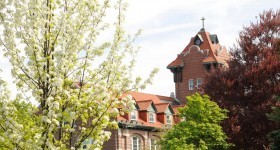
This year, construction has joined the bustle of academics, recreation, and leisure on the Saint Anselm College campus. Construction is proceeding on the historic Saint Joan of Arc Convent, the Carr Center, and a new residence hall.
In the spring of 2008, Father Jonathan DeFelice, O.S.B. announced:
- An estimated $9.5 million new residence hall
- $2.5 million in faculty offices and instructional space in the renovated Saint Joan of Arc Convent — now known as Joseph Hall
- And lastly, $2 million for a new fitness center in the Carr Center.
Although they now finish most of the external work on Joseph Hall, internal work will continue until the fall. After the Sisters of Saint Joan of Arc left, the building was stripped to the frame. With the new floor plan, the college upgraded utilities and ventilation to meet the demands of staff and students.
The Carr Center will get a new exercise center for the campus. The three-level complex will have an open plan with glass walls overlooking Sullivan Park and Grappone Stadium. The center will get new cardio, weight machines and free weights.
Alumni News on Saint Anselm College Blog
Jennifer Odell ‘96 on the Today Show
Saint Anselm alumna, Jennifer Odell ‘96 was interviewed by Al Roker, the Today Show’s weather and feature reporter. A senior scientist at the Georgia Aquarium, Odell discussed African black-footed penguins with Roker. Ole Odell also works with Beluga whales and California sea lions.
The Mystic Aquarium in Connecticut employed Odell as an aquarist for marine mammals and birds after she volunteered with penguins.
“For Jennifer Odell, every day is an intimate encounter,” said Portraits magazine in its winter 2004 issue. Her job is to care for the aquarium’s 21 penguins, four harbor seals, five Steller sea lions, and nine northern fur seals. In addition to training animals, she helps with research projects and meals. She’s got her dream job.
Lilly Wahl-Tuco ‘99 Working in U.S. Foreign Service
Lilly Wahl-Tuco, a senior at Saint Anselm College, never imagined she’d be the US ambassador to France. After graduating in 1999, she worked with non-governmental groups in Manchester before moving to Bosnia to study at the graduate level. In Bosnia, she considered working in the foreign service. ut Saint Anselm helped her get started in NGO work through volunteer and internship possibilities.
Then Lilly obtained her first job in Paris, France. After a few months as a consular officer, she became a Special Assistant to US Ambassador Craig Roberts Stapleton.
